

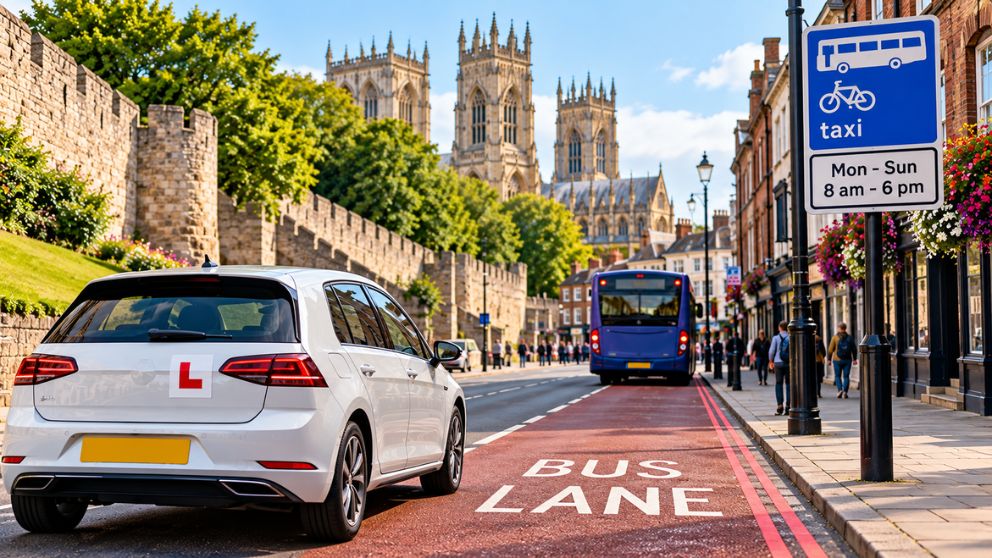
Learning to drive in York is an exciting experience, but navigating the city's bus lanes, pedestrian zones, one-way streets, and restricted roads can sometimes feel challenging, especially for beginners.
York is known for its historic streets, busy city centre, and extensive public transport network. While these features make the city unique, they also mean drivers must pay close attention to road signs, traffic restrictions, and changing traffic conditions.
Whether you're taking driving lessons in York, preparing for your practical driving test, or simply looking to improve your road awareness, understanding local driving restrictions is an essential skill.
In this guide, Regal Driving School explains how bus lanes work in York, which roads have important restrictions, and how learner drivers can navigate them safely and confidently.
Bus lanes are designated sections of road intended primarily for buses and, where signs permit, other authorised vehicles.
Their purpose is to improve public transport reliability, reduce delays, and help manage traffic more efficiently.
In York, bus lanes and other restricted routes help manage traffic around busy shopping areas, residential streets, and important transport connections.
However, not every bus lane operates in the same way.
Some restrictions apply only during specific hours, while others operate throughout the day and night. Certain routes may also allow taxis, cyclists, or other authorised vehicles.
Important: Just because another vehicle enters a bus lane doesn't mean your vehicle is permitted to follow it.
Always follow the signs displayed at the location.
If you're learning to drive in York, there are several locations where understanding road restrictions is particularly important.
Coppergate is one of York's important city-centre roads, connecting areas around Clifford Street, Nessgate, and Piccadilly.
It is also a location where learner drivers need to pay particular attention to bus lane restrictions.
According to City of York Council, access to Coppergate between its junctions with Clifford Street/Nessgate and Piccadilly is restricted between 8:00 am and 6:00 pm every day.
The permitted motor vehicles vary according to the time:
| Time | Permitted motor vehicles |
|---|---|
| 8:00 am – 10:00 am | Buses, taxis and private hire vehicles |
| 10:00 am – 4:00 pm | Buses, taxis, private hire vehicles and qualifying vehicles for loading |
| 4:00 pm – 6:00 pm | Buses, taxis and private hire vehicles |
| 6:00 pm – 8:00 am | No bus lane access restriction |
Bicycles are exempt from these Coppergate restrictions.
For most learner drivers in ordinary cars, the important point is that Coppergate is not a general through-route during restricted hours.
Even during the loading period, ordinary cars are not automatically permitted to use the route.
Driving tip: When approaching Coppergate, read the restriction signs early, identify whether your vehicle is permitted, and choose a legal alternative route if necessary.
Learn more from the City of York Council's Coppergate bus lane guidance.
Another location to be aware of is Low Poppleton Lane.
Unlike Coppergate, the enforced bus lane on Low Poppleton Lane operates 24 hours a day, seven days a week.
The council states that motor vehicles other than buses are prohibited from using the restricted section. Cyclists should use the shared cycle lane and footpath provided alongside the carriageway.
The restriction is monitored using Automatic Number Plate Recognition (ANPR) cameras.
Driving tip: Never assume that a quieter road is open to ordinary traffic. Always check the signs before entering a restricted section, even during evenings or weekends.
Further information is available on the Low Poppleton Lane enforcement page.
Bus lanes aren't the only restrictions learner drivers need to understand.
York has several pedestrian-priority streets, often referred to locally as footstreets.
These restrictions help create a safer environment for pedestrians, shoppers, cyclists, and other road users.
In much of the city-centre footstreet area, vehicle restrictions operate between 10:30 am and 5:00 pm daily, although individual streets can have additional restrictions or different access arrangements.
Important streets include:
Some locations have bollards or controlled access points.
Other streets, including Shambles and Stonegate, are closed to general motor traffic at all times, with specific authorised access or loading arrangements.
For learner drivers, this means a road that looks accessible on a map may not be legally open to ordinary vehicles.
Driving tip: Look for pedestrian-zone signs, access restrictions, operating times, and any exemptions before entering a street. Do not rely entirely on satellite navigation.
Always check the latest York footstreet restrictions.
Another important area for learner drivers is The Groves, located close to York city centre.
The Groves has a low-traffic neighbourhood scheme designed to reduce unnecessary through-traffic while maintaining access to homes and businesses.
Several streets have restrictions, traffic filters, or altered traffic directions.
These include parts of:
The area also includes one-way restrictions and specific turning requirements.
For example, parts of Brownlow Street and March Street operate as one-way streets, with exceptions for cyclists.
Learning to recognise these restrictions helps you improve your observation skills, planning, and awareness of other road users.
Driving tip: When driving through residential neighbourhoods, pay particular attention to one-way signs, no-entry signs, cycle exemptions, and road-closure points.
You can find further information about The Groves low-traffic neighbourhood on the council website.
Understanding traffic signs is an important part of becoming a safe and responsible driver.
According to the Highway Code, bus lanes are identified using road markings and signs showing which vehicles may use them and when restrictions apply.
1. Blue bus lane signs
These indicate that a lane is reserved for buses and any additional vehicle types shown on the sign.
2. Operating time signs
Some bus lanes operate only during certain periods.
Where no operating times are displayed on the relevant bus lane sign, the restriction normally applies at all times.
3. Bus gate signs
A bus gate is a short section of road reserved for buses and any other explicitly authorised vehicles.
It may restrict access to an entire route rather than just one lane.
4. No-entry signs
These indicate that vehicles must not enter the road from that direction.
5. Pedestrian-zone signs
These show that vehicle access is restricted, often during specific hours or for particular vehicle categories.
6. One-way street signs
These indicate the permitted direction of travel. Some one-way streets may also allow cyclists to travel in the opposite direction.
Learner drivers should become familiar with these signs before taking their practical driving test.
For the official rules, read Highway Code Rules 140–143.
In many situations, yes.
If a bus lane operates only during specific hours, ordinary vehicles may generally use it outside those hours, provided there are no other restrictions preventing access.
For example, Coppergate's bus lane restriction does not apply between 6:00 pm and 8:00 am.
However, Low Poppleton Lane has a 24-hour restriction, meaning ordinary cars cannot use the restricted section at any time.
The important lesson is that every bus lane must be assessed according to its own signs and restrictions.
Never assume all bus lanes operate under the same rules.
Certain bus lane restrictions in York are monitored by ANPR cameras.
If a vehicle enters a restricted bus lane without permission, the registered keeper may receive a Penalty Charge Notice (PCN).
City of York Council currently identifies Coppergate and Low Poppleton Lane as locations where bus lane restrictions are enforced using ANPR.
If you receive a PCN, the notice explains how to pay or challenge it and provides the relevant deadlines.
The most important thing is to avoid creating a dangerous situation.
Do not:
Instead, remain calm, maintain control, follow any lawful route available, and deal with the situation safely.
A driving mistake should never be made worse by an unsafe reaction.
During a UK practical driving test, examiners assess whether you can understand and respond appropriately to traffic signs, road markings, and restrictions.
Entering a restricted lane or ignoring a traffic sign can result in a driving fault, and potentially a serious or dangerous fault depending on the circumstances.
However, taking a wrong turn does not automatically mean you have failed your driving test.
If you miss an intended turning, continue safely and follow the examiner's subsequent directions.
Examiners are assessing your ability to drive safely and legally, not whether you know every street in York by memory.
This is why practising observation, road positioning, and decision-making is just as important as becoming familiar with local roads.
Whether you're learning in Acomb, Holgate, Clifton, Heworth, Fulford, Haxby, or another part of York, the following habits can help you navigate unfamiliar roads.
Look ahead for bus lane signs, speed limits, restricted turns, and pedestrian zones. Early observation gives you more time to react.
Never enter a bus lane simply because it appears empty. Make sure your vehicle is allowed to use it at that time.
If you're travelling near York city centre, review the route beforehand and check for access restrictions.
Avoid unnecessary lane changes and move into the appropriate lane early when it is safe.
York has many roads used by cyclists. Check mirrors and blind spots carefully, particularly when turning or crossing cycle lanes.
Roadworks, temporary restrictions, and diversions can change familiar routes. Slow down appropriately, observe the signs, and make safe decisions.
Professional driving lessons can help you become more comfortable with unfamiliar junctions, bus lanes, and restricted roads.
At Regal Driving School, we understand that learning to drive involves more than mastering the steering wheel, clutch, or accelerator.
It also means developing the confidence to handle real driving situations, including busy junctions, bus lanes, one-way streets, and unfamiliar traffic restrictions.
Our experienced driving instructors in York provide personalised lessons designed around your ability, experience, and learning goals.
We offer:
Whether you're a complete beginner or preparing for your practical driving test, our instructors are here to help you become a safe, confident, and independent driver.
Learner drivers must follow the same bus lane restrictions as other car drivers. You may use a bus lane when it is legally open to your vehicle, but you must not enter a restricted lane during its operating hours unless an applicable exemption permits it.
Yes. According to City of York Council, Coppergate's bus lane restriction operates from 8:00 am to 6:00 pm daily. Outside these hours, the bus lane access restriction does not apply, although drivers must still obey other road signs and traffic rules.
Yes. City of York Council uses ANPR cameras to enforce bus lane restrictions at Coppergate and Low Poppleton Lane.
Entering a restricted bus lane can result in a driving test fault. The severity depends on the circumstances, including whether the action creates danger or demonstrates a significant failure to observe traffic signs.
At Regal Driving School, lessons focus on developing road awareness, understanding traffic signs, and making safe driving decisions. Your instructor can help you practise relevant skills around York, including recognising restricted routes and choosing legal alternatives.
Understanding bus lanes and restricted roads is an essential part of learning to drive in York.
From the time-based restrictions on Coppergate to the 24-hour bus restriction on Low Poppleton Lane and the pedestrian-priority streets in York city centre, every learner driver should know how to recognise signs and respond safely.
Remember, the goal isn't to memorise every road restriction. It's to develop the observation, judgement, and confidence needed to drive safely wherever your journey takes you.
Ready to Start Driving Lessons in York?
Join Regal Driving School and learn with experienced instructors who provide supportive guidance, flexible lessons, and practical driving-test preparation.
